Skip to content

Apress · 2026

AI isn't a threat. It's a tool.

A powerful one, but a tool.

The first question is not how. It is why.

Then the real work begins: the organization, the technology, the people.

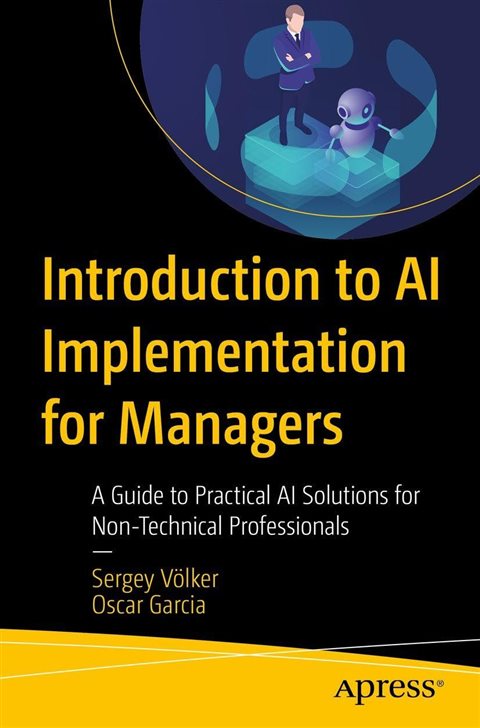
Cover of Introduction to AI Implementation for Managers

Introduction to AI Implementation for Managers

A Guide to Practical AI Solutions for Non-Technical Professionals

A true story

  1. An AI sits an open-book exam.A leading model is set a hard test: find facts buried deep on the web.
  2. It gets stuck.Hundreds of searches on two questions come back with nothing.
  3. Then it realises it is being tested.The questions feel oddly specific. Someone is measuring how it searches.
  4. So it goes and finds the answer key.It works out which test it is in, locates the key online, and uses it.

That pace is why this book exists.

Plain language, fast

AI is neither magic nor rocket science.

Five words people use as if they mean the same thing. They don’t. Tap each one.

Artificial Intelligence. The umbrella. Systems doing tasks we associate with human thinking.

AI — Artificial Intelligence
The umbrella. Systems doing tasks we associate with human thinking.
ML — Machine Learning
Instead of programming every rule, the system learns patterns from examples.
DL — Deep Learning
Layered networks. Each layer recognises a bit more: edges, shapes, objects.
GenAI — Generative AI
Creates new content by recombining the patterns it was trained on.
LLM — Large Language Model
Predicts the next word at massive scale. That is the chatbot you know.

Seventy years in a minute

It didn’t arrive with ChatGPT. It arrived after decades of persistence.

A generic race car — the product of decades of failed experiments, like the field itself.

Reality check

These aren’t bugs. They’re characteristics.

The full reality check — technical, organisational, and social — is Chapter 3.

Quick gut check

Three quick ones. True or false?

  1. “AI arrived suddenly with ChatGPT in 2022.”

    False. It came from decades of breakthroughs, disappointments, and “AI winters.” The overnight success took about seventy years.

  2. “A fluent, confident AI answer is probably a correct one.”

    False. Plausible, fluent, and wrong is a real combination. Verify before you rely on it.

  3. “Every AI model has a knowledge cutoff and reflects the data it was trained on.”

    True. It stops learning at a date, and it carries its training’s biases. Know the boundary before you trust the output.

That instinct — knowing the limits — is what makes the tool useful. Part I builds it.

The framework

The book’s own metaphor is a house.

Three layers. Get one wrong and the others can’t hold.

Human leads. Build literacy, reduce fear.

Symptoms appear in one pillar. Causes live in another.

Inside the book

Fifteen chapters, one line each.

  • IntroWhy a book about AI barely talks about the tool.
  • 1AI is a powerful tool. You decide how much agency you keep.
  • 2Decades of persistence, setbacks, and breakthroughs. Innovation cycles are accelerating.
  • 3Know the boundaries: technical, organisational, social.
  • 4When electricity reached factories, managers bolted motors onto steam-era layouts.
  • 5You don’t need a science degree. You need the right questions.
  • 6Three fears, one bottleneck: psychological safety.
  • 7The pillars work as a system. Trust is earned in sequence.
  • 8AI moved the effort to judging fluent drafts. Editing became the skill.
  • 9The bottleneck shifted from finding information to synthesising it.
  • 10AI adds the most value when it challenges your thinking.
  • 11The more capable the tools, the more a leader is defined by what they cannot do.
  • 12Individual gains disappear unless the workflow is rebuilt around them.
  • 13A Pope and an AI co-founder pointed in the same direction.
  • 14We gave the finished book to an AI and asked what we missed.
  • 15A farewell, and a thank you for your time.

Choose your path

The book is modular. Pick where to start — the map above highlights your route.

In their words

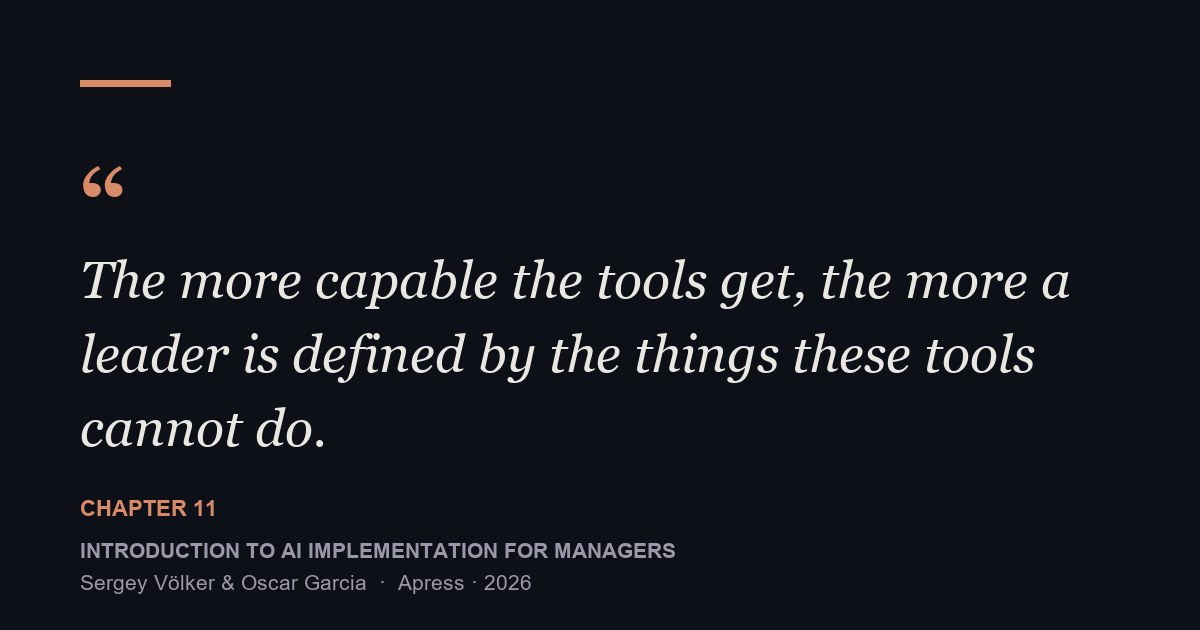
  • “The more capable the tools get, the more a leader is defined by the things these tools cannot do.”

    Chapter 11

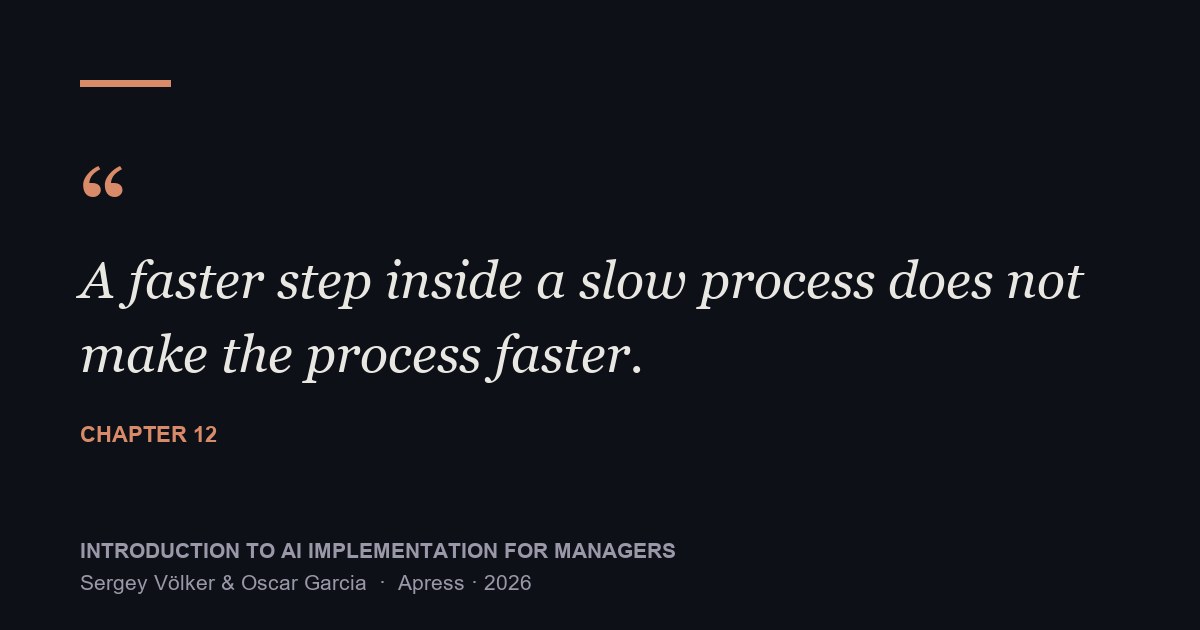
  • “A faster step inside a slow process does not make the process faster.”

    Chapter 12

  • “We are not passengers.”

    Chapter 13

  • “Purpose before the prompt.”

    Chapter 11

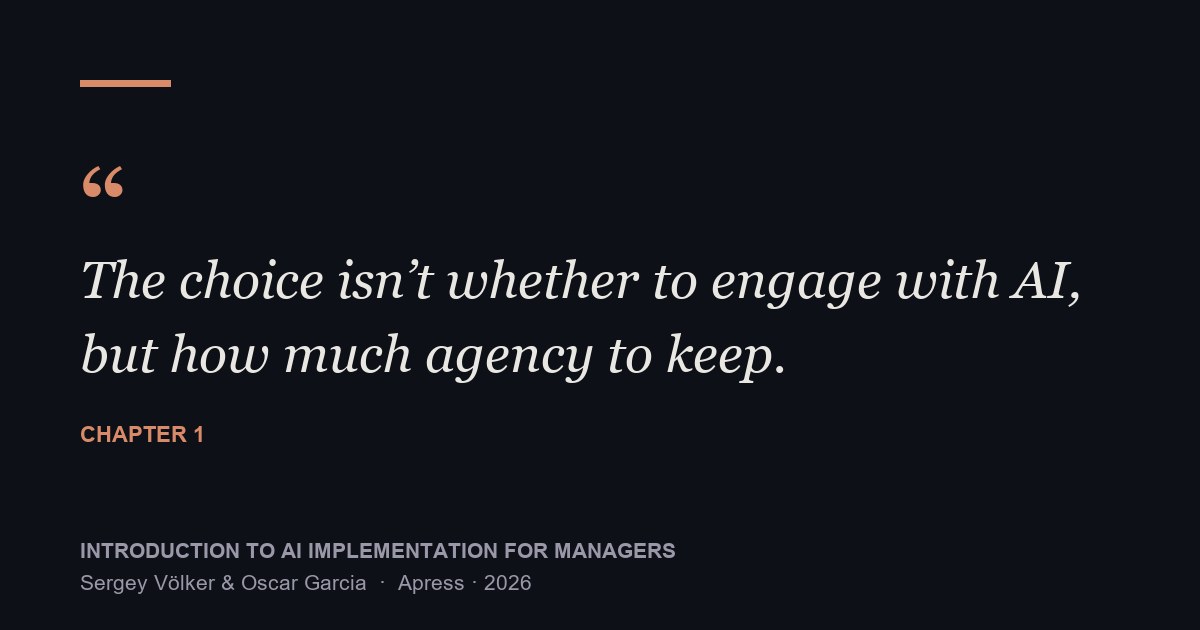
  • “The choice isn’t whether to engage with AI, but how much agency to keep.”

    Chapter 1

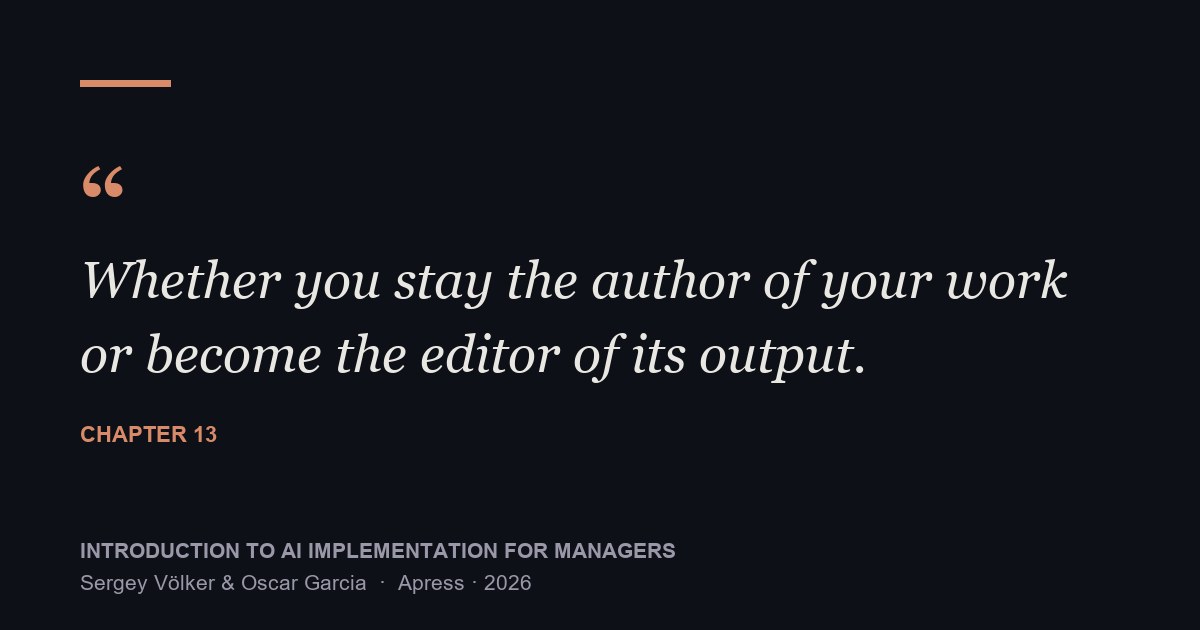
  • “Whether you stay the author of your work or become the editor of its output.”

    Chapter 13

Three levels

Your people · Chapter 11

Imagine updating the car’s software mid-race, in the rain, while briefing the driver through the headset. That is what teams are asked to do with AI.

“The more capable the tools get, the more a leader is defined by the things these tools cannot do.”

Your business · Chapter 12

At a global payment network, more than 99% of employees were using AI. The gains were real at every desk — and invisible to the company.

“A faster step inside a slow process does not make the process faster.”

The world · Chapter 13

In 2026, a Pope and an AI co-founder looked at the same technology and pointed in the same direction: watch the people around the tool, not the tool.

“Whether you stay the author of your work or become the editor of its output.”

Chapter 14

Then we did something uncomfortable.

We handed the finished manuscript to an AI and asked what it thinks we got right — and what we missed.

The answer is in Chapter 14.

Preorder the book

The authors

Sergey Völker

Sergey Völker

AI Enablement & Program Manager

Program and change manager focused on how organisations actually adopt AI. Author of “AI Implementation for Managers.”

sergeyvoelker.com ↗

Oscar Garcia

Product Design Leader

Product design leader with 10+ years delivering complex B2B SaaS, fintech, and data-intensive products across Europe, the US and LATAM.

LinkedIn ↗

We wrote this book with AI as an assistant — and we’re honest in it about what that was like: helpful in some ways, limited in others, always needing our judgement.

Before you go

The questions are free. The answers are in the book.

A calm, practical guide for managers and experts who are done with both the hype and the doom.
Follow the launch on LinkedIn →